Where AI drafts and you decide: drawing the approval boundary
Every workflow starts with explicit boundaries. The team may draft, but you approve messages and public posts, appointments and commitments, and listing facts and regulated language. Some things are never delegated at all.
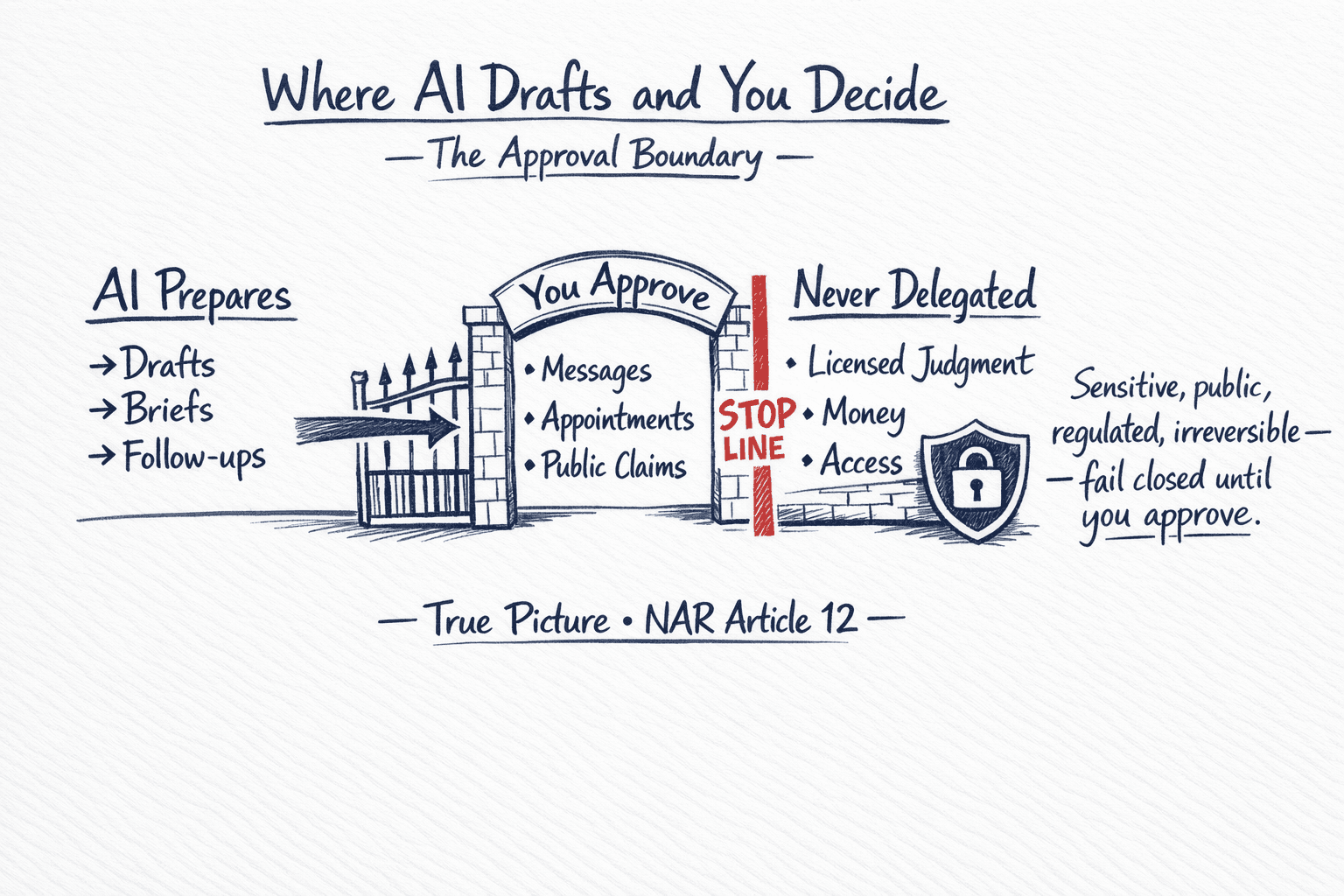
The most important document in any implementation is not the integration map. It is the boundary memo — the one-page record of what the team may draft, what you approve, and what it never touches. Sensitive, public, regulated, and irreversible actions fail closed until you approve them. That rule is not an aspiration. It is how the system is built.
The three buckets
- The team prepares: lead and client follow-up drafts, pipeline and exception briefs, content and update drafts — always held for approval.
- You approve: messages and public posts, appointments and commitments, listing facts and regulated language — any claim that could mislead if wrong.
- Never delegated: licensed or legal judgment, money movement, access and policy changes — the team has no path to do these, even if asked.
What this looks like in practice
A listing description comes back with two variants — both citing only the approved fact sheet — and a note that says 'fair-housing pass complete, no familial-status language detected, awaiting your approval.' An inquiry reply arrives with the sender's prior phrasing reused, two calendar holds you actually have, and a flag: 'price claim included — approval required.' The system does not decide what is safe to send. You do.
Questions we hear
Does the approval step slow us down?
It speeds up the right things. Drafting is immediate; approval is batched to your rhythm and detaches the decision from the writing. You make one decision per item — approve, edit, or skip — instead of writing from scratch.