After you ship: post-launch operations for vibe coders and indie builders
You shipped in 48 hours with AI. Then onboarding, support, billing, and changelog quietly consumed the next 48. How to run what comes after — without hiring a team before you have revenue to justify it.
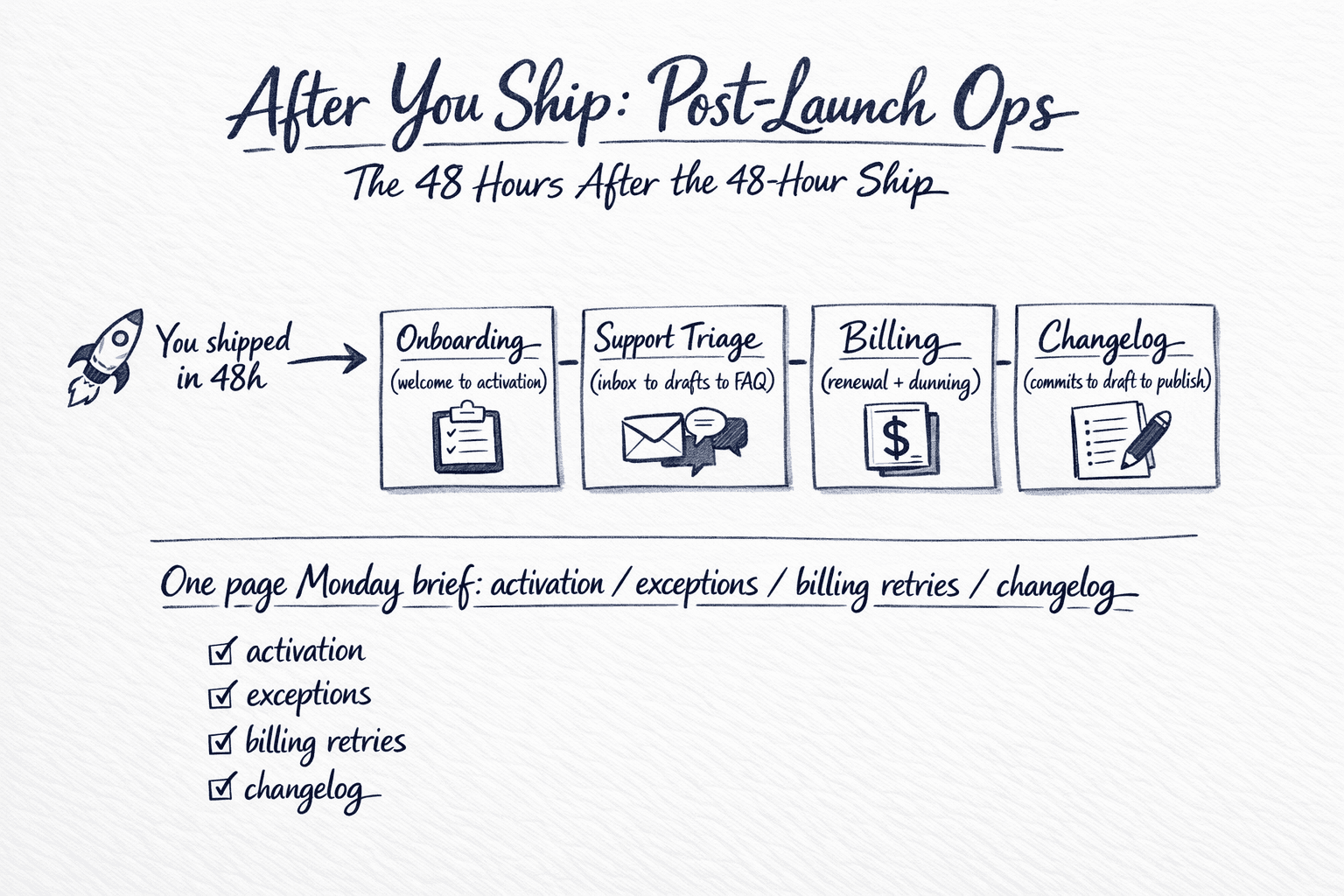
Shipping is the celebrated half. The uncelebrated half is what happens between signup and second-week retention: welcome that actually lands, activation that does not depend on you noticing, support that triages before it burns your morning, billing that follows through without feeling aggressive, and a changelog that exists because commits happened — not because you found time to write one.
From signup to retained — four workflows
Each of the four loops below is drafted-and-held: the team prepares the next touch from real events and your approved language, you approve before it sends, and every thread has one owner and one dated next action. No silent automation, no invented claims.
1. Onboarding from signup
- Welcome sequences tied to your auth and event source — GitHub, Stripe, or whatever holds the signup — so every new user gets a real welcome, not a delayed afterthought.
- Activation nudges based on actual product events (first project created, first invite sent), each drafted and held for your approval, with a named fallback if activation stalls.
- Clean handoff to support: if onboarding detects repeated questions or a stuck step, it routes to triage with context — not to your personal inbox at midnight.
2. Support triage and FAQ drafts
- Inbox triage with tags — bug, how-to, billing question, feature request — so you see exceptions, not the whole firehose.
- Draft replies pulled from real past answers and your approved voice, held for your one-tap approval; public-facing language never sends without you.
- FAQ updates drafted from recurring questions, with source links to the threads that prompted them — approved once, reusable without re-deciding.
3. Billing follow-up and dunning
- Renewal and failed-payment follow-through on a humane cadence — reminders before charge, then retry nudges after — each draft held for your approval on language and timing.
- Identification and opt-out on every message, suppression when a personal conversation is recent, and no language that promises access or threatens it without your sign-off.
- Ledger-tight logging: retries scheduled, logged to Stripe and your CRM, and visible in the weekly brief as billing retries owed — not hidden in Stripe alone. See where we draw the full boundary.
4. Changelog and release notes
- Weekly changelog drafts assembled from commit messages, merged PRs, and shipped fixes — deduplicated and plain-English summarized, held for your approval.
- Published where users actually look — in-app, email, or X — from one approved source, so the changelog is not a memory exercise on Sunday night.
- Version-stamped and linked to the fix or issue, so users can trace what changed without chasing you in support.
The stack stays yours
You live in GitHub, Stripe, email, and a support inbox. That is the stack we operate around. The team does not ask you to migrate; it keeps the handoffs between those four places from depending on your memory. Sensitive, public, and commitment-creating actions fail closed until you approve them — a one-page boundary memo signed before go-live.
Where this fits in your operating system
Onboarding → support → billing → changelog sits beside the founder loops: see the founder doing five jobs for investor updates, hiring ops, and onboarding at pre-seed to Series A. Both use the same human-approval boundary and live day one, tailored together path — one workflow proven end-to-end before the next is scoped.
Questions we hear
Is this for technical founders only?
It is for anyone who shipped with AI's help and now carries onboarding, support, and billing alone — solo developers, indie hackers, and small product-led teams shipping weekly. The operating team adapts to your stack, not the other way around.
Do you write code or build the product?
Yes. Startup SaaS includes a $5,000 prototype setup, then $500 per month for ongoing vibe-coding and product support. The exact prototype scope and monthly boundaries are confirmed before work begins.
Will billing follow-up feel spammy or risky?
No. Billing drafts are held for your approval on language and timing, carry clear identification and opt-out, and respect suppression rules (recent personal conversation, recent opt-out). The team never charges a card or changes entitlements without your explicit approval — that fails closed by design.