
The founder doing five jobs: operating without hiring three people first
Pre-seed to Series A, the constraint is not ideas. It is follow-through across investor, hiring, and customer loops. How to install the operating rhythm without the headcount — and keep approval where it belongs.
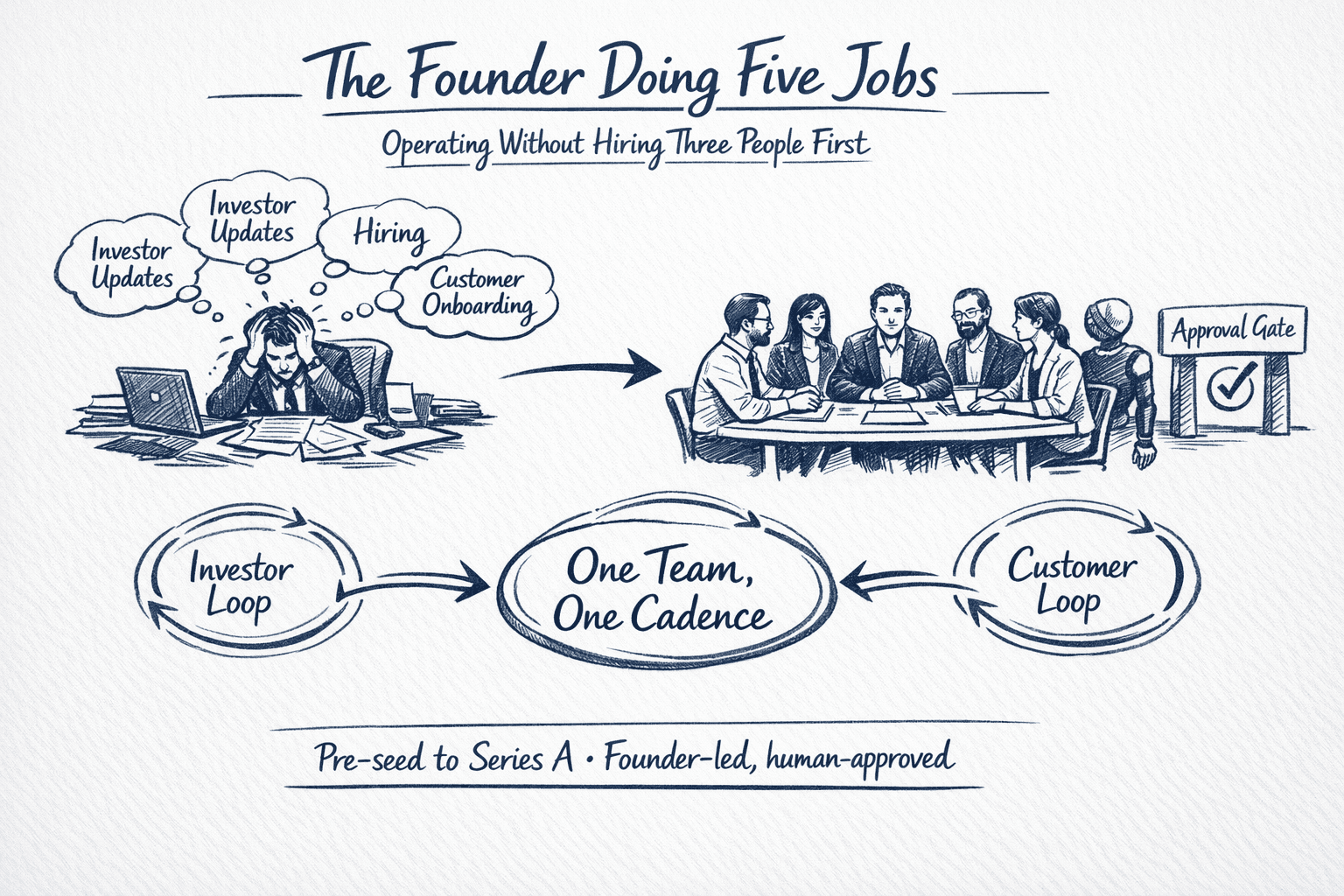
The seed-stage founder's calendar tells the story: investor follow-ups that should have gone yesterday, candidates who went cold between interviews, and new customers who signed up and then heard nothing for a week. Each loop is simple. Together they are the reason nothing feels done. The headcount to run them — an ops hire, a hiring coordinator, an onboarding specialist — does not exist yet and should not be the first spend.
Three loops, one team
Investor, hiring, and customer loops each decay for the same reason: no single owner for the next action, no dated follow-up, no draft ready for approval when the window opens. One managed operating team — Marcus coordinating a five-role core — keeps all three moving through the tools you already use (inbox, calendar, CRM). The tradeoff is explicit: you get the rhythm before you earn the headcount, and scope is confirmed before anything ships.
1. Investor updates and pipeline
- Monthly update drafted from your numbers — metrics, pipeline, asks, and next milestones pulled from your source of truth — held for your approval before any send. No invented traction, no forecasted close presented as fact.
- Pipeline follow-through between updates: nudges, introductions, and next-step routing tied to inbox and calendar, not memory. Every thread has one owner and one dated next action.
- Fundraising commitments, terms, and forward-looking statements flagged approval-required by default. The team may summarize and propose language; only you decide what gets promised.
2. Hiring ops and interview coordination
- Candidate intake and follow-through: every inbound has an owner, a next touch dated within 24 hours, and a draft reply in your voice — held for approval. No candidate decays between stages because Tuesday got busy.
- Interview coordination: scheduling, confirmations, and prep briefs routed through your calendar with draft comms held for approval. Compensation, title, equity, and offer language always approval-required.
- Language guardrails: role descriptions and outreach avoid discriminatory or over-promising claims; any commitment about process, timeline, or decision is drafted, not sent, until you sign it. See the approval boundary for where we draw that line.
3. Customer onboarding and renewal
- Onboarding sequences tied to signup and activation milestones — welcome, setup nudge, value check-in — each drafted and held for your approval, not auto-broadcast. Every new customer has a dated next touch.
- Milestone and renewal communication: expansion nudges and renewal reminders on a consistent cadence, with suppression rules (recent personal conversation, recent opt-out, unresolved support issue) so asks are earned, not blasted.
- Support handoff built in: onboarding exceptions (stuck activation, repeated questions) route to triage with draft FAQ updates, keeping onboarding and support from competing for your attention.
Where approval lives for startups
The boundary memo is not a metaphor. It is the same one-page operating contract used in real-estate workflows, with startup terms flagged instead of property claims. Any commitment about hiring, pricing, fundraising, or product dates is approval-required. Licensed or legal judgment is never delegated. The team prepares the draft, the context, and the next action — you make the call. Edits you make train the next draft, but never bypass the gate.
Where this fits in your operating system
Investor and hiring loops sit next to post-ship operations: see after you ship — post-launch operations for builders for the onboarding → support → billing → changelog counterpart. The same human-approval boundary and live day one, tailored together path govern both — one workflow proven before the next.
Questions we hear
We already have a CRM. Do we need another?
No. The operating team works around the CRM, inbox, and calendar you already have — keeping the next action moving instead of replacing the datastore.
Who approves hiring and investor communications?
You do — every time. Drafts are prepared from your numbers, pipeline, and prior approved language, but any commitment about compensation, equity, fundraising terms, or product commitments is approval-required and fails closed until you sign it. The team never sends offer or investor language on your behalf.
Does follow-up risk spamming candidates or investors?
No. Every sequence is drafted-and-held with suppression rules (recent reply, recent personal conversation, explicit opt-out) and identification on the send. Nurture earns permission by reply; it does not assume it. Approval sees the context, not just the draft.